-
Before Anything: Which 'Solar System' Are You Searching For?
-
Step 1: Verify the Maxeon Solar Panels Use Actual IBC Technology
-
Step 2: Verify the Country of Manufacture and Origin Before the PO
-
Step 3: Read the 40-Year Warranty Like a Contract, Not a Sales Page
-
Step 4: Buy One Panel Before You Buy One Hundred
-
Step 5: Substantiate Environmental Claims (FTC Green Guides Apply)
-
Step 6: Model the Real Performance Before You Commit
-
Step 7: Match Serial Numbers From Manufacturer to Pallet
-
Red Flags: When to Walk Away
-
Bottom Line
Before Anything: Which 'Solar System' Are You Searching For?
Quick honesty: most people looking up "what is the solar system made of" want astronomy. Gas giants, the Kuiper belt, the outer solar system. I can't help with that.
But a good chunk of you are searching for the other solar system—the one on a warehouse roof, made of Maxeon solar panels, an inverter, racking, wiring, and a surprising amount of paperwork. That I can help with.
Here's my background: I've handled procurement for commercial solar installations since 2019. I've personally made (and documented) six significant mistakes, totaling roughly $14,000 in wasted budget. That's what built this checklist. Our team uses it for every premium panel order, and this is the version I'd hand to anyone evaluating Maxeon solar panels for a commercial, industrial, or large residential project.
Seven steps, each with one concrete check. Plus the red flags at the end. Let's get into it.
Step 1: Verify the Maxeon Solar Panels Use Actual IBC Technology
Not every panel with "back contact" on the datasheet uses Interdigitated Back Contact (IBC) technology. And not every "Maxeon-compatible" cell is a genuine Maxeon cell. Those two words—compatible and genuine—do a lot of work.
Here's the physical check: hold the panel so light hits the front surface at an angle. If you see thin grid lines or busbars running across the cell, it's not IBC. Genuine Maxeon IBC cells have a clean, uniformly dark front face, because the electrical contacts sit on the rear. That architecture is what lets the Gen III, 6, 7, and 8 series reach their efficiency numbers (24%+ in several cases, per their spec sheets).
The belief that IBC panels are fragile or only for luxury residential projects was true in an era when the technology was new and production volumes were small—back when Maxeon's predecessor, SunPower, was just about the only company doing it. Today, IBC panels run through the same mechanical stress testing as standard mono-PERC panels. IEC 61215 certification doesn't give IBC a free pass. So the old fragility argument mostly doesn't hold.
Checkpoint: ask for a close-up photo of the cell surface if you can't inspect a physical panel. Front-side metallization means it's not IBC, no matter what the product page says.
Step 2: Verify the Country of Manufacture and Origin Before the PO
Country of origin sounds like a logistics detail until it costs you a project. Then it's a budget line.
Maxeon solar panels are made across multiple sites. The IBC cells are historically produced in the Philippines and Malaysia, while module assembly happens closer to regional markets—Mexico, France, and China depending on the product line. I'm not 100% sure whether every market gets cells from the same plant, but the certificate of origin will tell you exactly where your specific units came from. That document is the thing to ask for.
This one burned us for $1,900. We ordered panels for a project that required EU-manufactured content. The panels arrived on schedule, but the paperwork said "Country of Origin: Malaysia." We had never asked the supplier to confirm the origin in writing. Two weeks of rework and several uncomfortable phone calls later, we learned our lesson: check the origin docs from the exact plant that will fulfill your order, not the company brochure.
Checkpoint: request a sample certificate of origin or export documentation from the fulfillment plant before you sign the purchase order. Match every line item.
Step 3: Read the 40-Year Warranty Like a Contract, Not a Sales Page
Maxeon's 40-year linear power warranty is one of the longest in the industry, and it's a genuine differentiator. I want to say the guaranteed output at year 40 lands around 89–90% of nominal, but don't quote me on that exact number—warranty terms evolve, so check the current datasheet.
But here's what I actually learned by losing money: the power degradation table is not the whole contract. You also need to read the exclusions:
- Power warranties cover electrical degradation, not mechanical damage. A cracked panel from a forklift accident is not a warranty claim.
- Several claim processes require the original installation invoice, not just your purchase order. Keep both in a project file.
- Shipping damage falls to the freight claim, not the manufacturer. That's a separate process with its own deadlines.
We lost $2,300 on a freight claim because we assumed the panel manufacturer would handle it. To be fair to them, the warranty document was clear—the exclusions were all in the PDF. I just hadn't read past the chart. Now we treat the warranty document like the contract it is.
Oh, and one more thing worth pricing in: if your investment horizon is shorter than 10 years, a standard 25-year warranty might serve you just as well. That's a real trade-off, not a marketing line.
Step 4: Buy One Panel Before You Buy One Hundred
This is the step that has saved us the most money, and it's also the one most buyers skip because it feels slow.
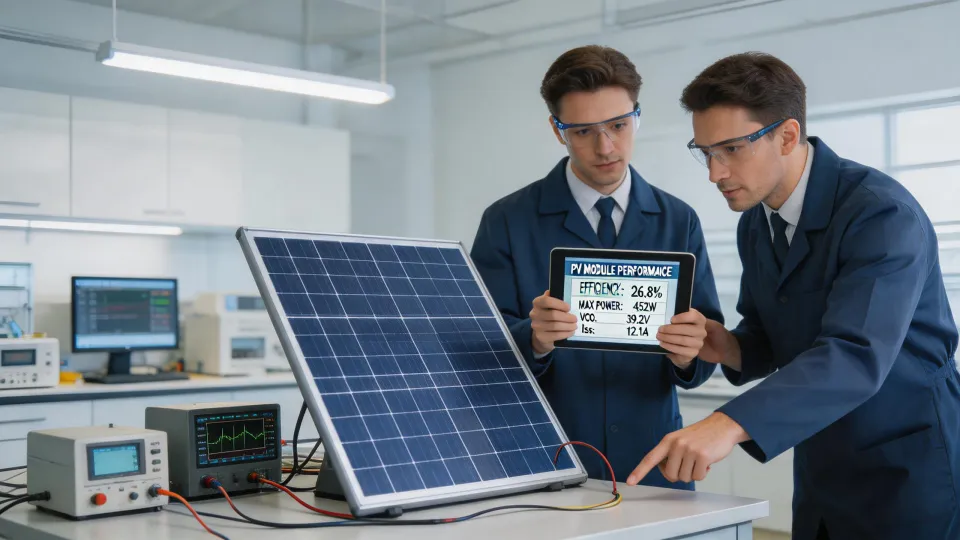
The method: order a single sample panel through the same channel you'll use for the bulk order. Not the "sample route"—that often gets hand-picked units that don't represent the batch. Then bench test it: measure Voc, Vmp, Imp, and Pmax under a known load on a sunny day, and compare against the datasheet at the same irradiance and temperature.
Never expected a $5,000 testing instrument to pay for itself in one afternoon. But our first sample delivered 96% of its rated Pmax. Within tolerance, sure. But it also told us those panels ran on the lower end of the spec range, so we negotiated a tighter test criterion for the full order.
Plus, if your project involves a 400 watt solar generator or a small test rig, the same sample panel doubles as commissioning practice. Use the same cabling, mounting, and charge controller you'll use in the real install. A panel that underperforms on the bench will not improve once it's on the roof.
Checkpoint: if the vendor resists selling you one panel first, that's a red flag on its own.
Step 5: Substantiate Environmental Claims (FTC Green Guides Apply)
Here's the part of panel procurement that most buyers skip: environmental marketing claims.
Per FTC guidelines on advertising truthfulness, claims like "recyclable" or "eco-friendly" have to be substantiated. The FTC Green Guides (16 CFR Part 260) say an item advertised as "recyclable" should be recyclable for at least 60% of the consumers who have access to recycling facilities. That's a real regulatory standard, not a vibe.
The surprise wasn't that a supplier greenwashed their panels. It was how common it was. We asked one for their "zero waste" evidence, and they sent a 2018 brochure. That's not substantiation—that's a PDF that has been collecting dust.
Checkpoint: ask for written evidence of any environmental claim before the PO. If a sales rep says "fully recyclable," ask where the take-back program operates. If they can't answer, lower their score, no matter how good the price is.
Granted, this means extra emails and a slightly longer sales cycle. But for buyers who report to ESG stakeholders—or who just don't want to pay for someone's marketing fiction—the evidence is the product.
Step 6: Model the Real Performance Before You Commit
Datasheet numbers come from standard test conditions: 25°C cell temperature, 1000 W/m² irradiance, and no dirt. Real roofs run hotter. Real skies are cloudier. Real panels collect dust.
Put the Maxeon specs into PVsyst or Helioscope using your exact site location and tilt. Pay attention to the temperature coefficient of Pmax—this is one area where Maxeon's IBC technology genuinely stands out. A lower temperature coefficient means better yield on hot days. In Texas, Spain, or the Middle East, that's a measurable advantage, not a footnote.
But then again, if your site is in Scotland, the temperature coefficient matters less and low-light behavior matters more. Every site has its own physics. The checklist step is to model, not assume.
Trust me on this one: we modeled our last 300 kWp warehouse array four different ways before ordering. The difference between worst-case and best-case assumptions was about 18% annual yield. That's the difference between a 6-year payback and an 8-year one.
Step 7: Match Serial Numbers From Manufacturer to Pallet
The last step is the most bureaucratic one, and it's the one that catches the biggest errors.
Before the shipment leaves the supplier, request the complete paper trail: commercial invoice, packing list, certificate of origin, and bill of lading. When the pallets arrive, match the serial numbers printed on the panel frames against the packing list. Every single one.
There's something satisfying about opening a pallet and ticking off every serial number in one pass. After the 2022 delivery where the vendor shipped the wrong module series—same brand, different wattage—and nobody noticed until the installer was on the roof, serial-number matching became a mandatory completion criterion. "The serial numbers matched on paper" is a sentence you never want to hear at the end of a project.
Actually, I should add one more benefit: in incentive programs that tie rebates to module origin or efficiency class, serial-number traceability is exactly what the auditors want. A missing document can delay an incentive payout by months. Ask me how I know.
Checkpoint: put a sign-off step in your receiving process that explicitly confirms the serial numbers on the pallet match the packing list.
Red Flags: When to Walk Away
These are the warnings I've collected the hard way, plus a few borrowed from colleagues. All of them are worth taking seriously.
- "Maxeon-style" or "IBC-compatible" cells. If the listing doesn't say genuine Maxeon, it isn't. The label exists for a reason.
- Origin documents that don't match the pallet. If the certificate of origin says one country and the product stickers say another, stop the unload.
- A "warranty like Maxeon's" at a discount. A 25-year warranty is not a 40-year warranty. Every year of coverage has a financial value.
- Prices 20% below market. In 2024, we almost bought "factory seconds" from a middleman at a steep discount. The certificates were photoshopped. That one still makes me angry to think about.
Bottom Line
Maxeon solar panels are a strong choice when you need top-tier efficiency, low degradation, and the longest warranty in the business. The IBC technology is real, the performance is documented, and the 40-year warranty changes the financial math for long-term owners.
But the panel itself is only half the procurement game. The other half is paperwork, verification, and refusing to trust a sales pitch at face value. That's what this checklist is for. Six figures of panel orders later, it's the difference between a smooth project and a $14,000 tuition payment.
Ask a related Maxeon question