-
Where Are Maxeon Solar Panels Manufactured?
-
Maxeon vs REC Solar Panels: Which Should You Specify?
-
Can Maxeon Panels Charge a 400 Watt Portable Power Station?
-
Is the Garmin Fenix 7x Pro Solar Battery Life Real?
-
Are Wind Turbines or Solar Panels Better?
-
What Should You Verify Before Buying Maxeon Panels?
I run quality compliance at a solar procurement firm, which means I review photovoltaic modules before they ship to customers. That's roughly 200 unique batches a year, and I've rejected about 14% of first deliveries in 2024 over spec deviations. Lately, six solar questions keep coming up. These are the answers I actually give.
Where Are Maxeon Solar Panels Manufactured?
The country-of-origin question is more nuanced than a label suggests. Maxeon Solar Technologies is a Singapore-headquartered company, but the manufacturing happens mostly in Southeast Asia — specifically, IBC cell and module production has been concentrated in Malaysia (Melaka fab) and the Philippines (Batangas facility) since Maxeon's 2020 separation from SunPower.
Buyers often equate "Singapore HQ" with "made in Singapore." They're different. Your shipment will most likely be documented as Product of Malaysia or Product of the Philippines depending on where it was assembled. And that distinction matters more now than it did a few years ago, because tariffs, domestic-content incentives, and even freight insurance hinge on the actual origin. Get the country-of-origin certificate before you sign, not after.
What I mean is: brand registration is not a proxy for production location. If I remember correctly, Melaka has carried a larger share of Gen 7 cell output, but Maxeon's fab loading changes over time — so verify the current allocation for the specific batch you're buying.
Maxeon vs REC Solar Panels: Which Should You Specify?
The Maxeon vs REC comparison comes up in almost every competitive bid I evaluate. Both brands sit in the premium tier, but they took different technology paths. Maxeon builds IBC (interdigitated back contact) cells, where all contact fingers are on the back and the front surface stays fully exposed. REC's premium Alpha series uses heterojunction (HJT), which layers amorphous silicon around a crystalline wafer.
On paper, both produce excellent specs:
- Efficiency: Maxeon Gen 7 and REC Alpha both claim roughly 22–24% module efficiency depending on the model. Don't let a 0.3% spec difference dictate the choice — site conditions will drown it out.
- Temperature behavior: IBC and HJT both beat conventional PERC in warm climates. Maxeon's temperature coefficient is around −0.29%/°C for many models; REC's HJT is similarly strong.
- Warranty: Maxeon's flagship offering is a 40-year linear power warranty. REC offers 25 years. For a project financed over three decades, that period matters — but so does the issuer's solvency. A warranty is only as durable as the company behind it.
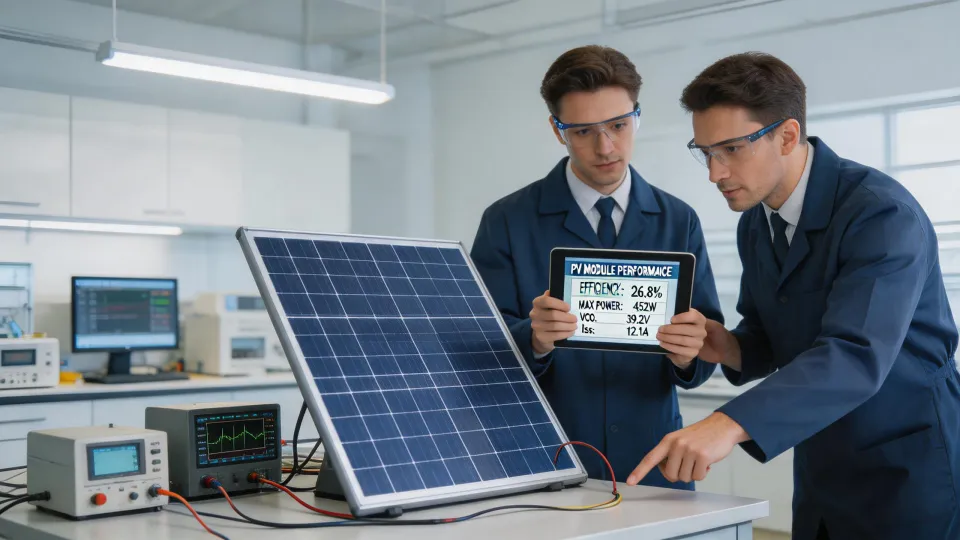
In Q1 2024, we had two vendors present competing bids — one pushing Maxeon, one REC — each with datasheets claiming superiority in accelerated degradation tests. We did independent flash testing on both (which, honestly, we should have done before accepting the first round of bids). Cost about $1,800 in lab fees, but the results contradicted one brochure's headline claim. That's why the spec comparison is only a starting point. You verify. Then you decide.
Can Maxeon Panels Charge a 400 Watt Portable Power Station?
No — at least not in any practical sense. I see this question from off-grid enthusiasts who assume "one solar panel is as good as another." A 400 watt portable power station (think Jackery or EcoFlow) accepts DC input in a narrow voltage range from portable/folding panels, or AC wall power. A Maxeon 440W rooftop module is a rigid glass panel designed to be mounted permanently, and its string voltage is far above what a portable power station's MPPT input can handle.
You'd need additional charge controllers, correct cabling, and a mounting solution before you even think about plugging it in. At that point, you've spent more than the power station itself on accessories — and if the input voltage exceeds the rating, you can damage the unit.
Want reliable portable power? Buy the panel that the power station manufacturer specifies. The Maxeon module is engineered for fixed installations with a 30-year design life. It's not a campsite gadget. Let me rephrase: it can generate power off-grid, but it's the wrong tool for a portable battery pack.
Is the Garmin Fenix 7x Pro Solar Battery Life Real?
The Garmin Fenix 7x Pro solar battery life is genuinely good for a smartwatch — Garmin quotes up to 37 days in smartwatch mode with sufficient solar exposure. But it's not "infinite battery."
Here's the nuance I keep explaining to clients and friends: the solar layer in that watch is designed to offset power consumption, not to charge the device like a wall charger. In GPS-heavy use, solar gain becomes a small fraction of drain. In standby mode, it extends the runtime meaningfully. Both behaviors are useful, but they're fundamentally different from what a solar module does on a roof.
The Fenix 7x Pro uses Power Glass over the display, which is optimized for low light and partial shading. That's the opposite design goal of a rooftop IBC panel, which is optimized for maximum yield under full, direct sunlight. Comparing them is like comparing a bicycle dynamo to a hydroelectric dam. Both generate electricity, but the similarity ends there.
Are Wind Turbines or Solar Panels Better?
It depends on the context, but I can offer a clear rule of thumb from a quality-assurance perspective: solar is easier to trust over long periods. Photovoltaic modules have no moving parts. Wind turbines have gearboxes, bearings, blade erosion, and yaw systems that introduce more failure modes. Every moving component is a future maintenance line item.
That's not to say wind is bad — at utility scale with a strong wind resource, turbines can reach 35–45% capacity factors, while solar often sits at 18–22% in temperate climates. But solar plus battery storage now competes with wind in many markets, and solar deployment timelines are shorter.
If I'm evaluating equipment quality, solar panels are also easier to test and compare thanks to standardized STC ratings and decades of field data. Wind equipment has improved too, but the design iterations keep changing every few years — which makes long-term reliability predictions harder. By 2025, though, solar and wind aren't mutually exclusive. The best hybrid projects combine both where the site allows, balancing generation profiles and grid interconnection costs.
What Should You Verify Before Buying Maxeon Panels?
I'll finish with a few checks we run on every Maxeon order:
- Serial numbers and labeling. Confirm the label's maximum power class matches the datasheet. We once received a batch with swapped labels — the modules were physically correct, but the documentation was wrong. We rejected all 840 pieces.
- Country-of-origin certificate. Get it in advance if tariffs or incentives apply to your project.
- Warranty registration terms. Maxeon's 40-year warranty has specific documentation requirements. File the registration immediately after delivery; don't rely on the distributor to do it.
- Connector and cabling compatibility. Maxeon has used proprietary connector approaches in some lines. Confirm they match your inverter and monitoring setup before installation day.
Full disclosure: I nearly skipped the label check in 2022 because "it's always the same." That was the one time it wasn't — the batch came with two different power classes, mixed in the same pallets. Now the verification protocol includes label scanning on every pallet. You don't learn to be careful by having everything go right. You learn it when something slips through.
Solar technology has changed fast since 2020 — IBC and HJT are mainstream, warranty horizons stretched to 40 years, and module efficiencies keep climbing. The fundamentals of quality control haven't changed, though: verify everything, trust nothing until it's tested. That's the mindset that keeps a project alive for the long run.
Ask a related Maxeon question