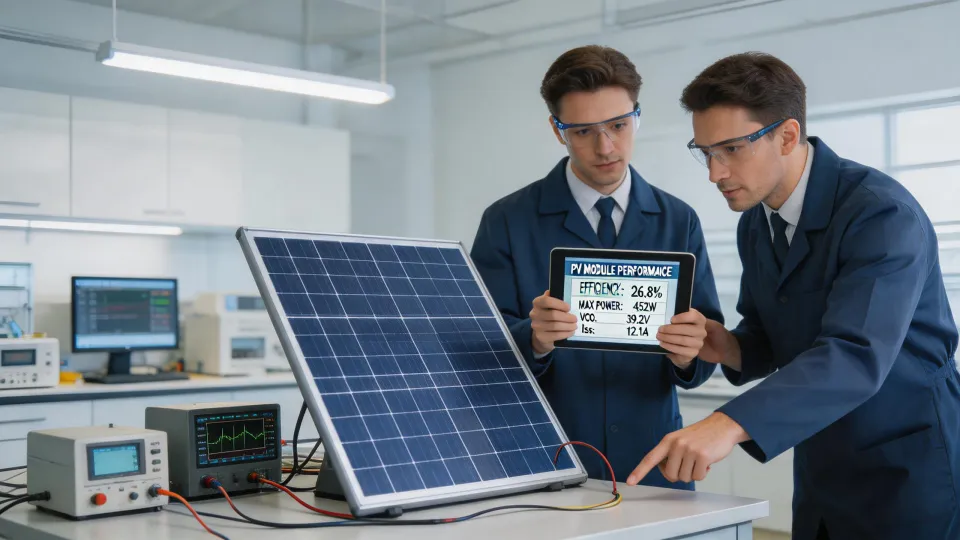
I've been reviewing solar modules for four years. Not selling them. Not installing them. Checking them—batch after batch, before they get anywhere near a roof. I'm a quality and brand compliance manager at a renewable energy company, and I review every incoming PV module shipment before it reaches installers. Roughly 200 shipments a year. In 2024, I rejected 6% of first deliveries due to power binning and visual defects. That ratio is not a badge of honor. It's a reminder that the datasheet and the delivery are often two different animals.
Here's my opinion, plain and simple: the most efficient solar module isn't the one with the highest nameplate efficiency. It's the one that shows up exactly as specified, performs as promised for decades, and costs the least in replacements, return visits, and lost trust. That's lifecycle efficiency. It's harder to measure than a lab number, but it's the only metric that matters in a 25-year asset.
Efficiency Is Not a Datasheet Number
The conventional wisdom says: compare datasheets, calculate price per watt, sign the PO. My experience with 200+ shipments suggests otherwise. The conventional wisdom is about math. Real solar procurement is about materials, tolerance, and what happens when a pallet sits in the sun at a construction site.
In our Q1 2024 quality audit, we received a batch of 2,400 modules where the power binning was visibly off—10 W below the marked nominal against our ±3 W tolerance. The vendor called it 'within industry standard.' I called it a rejected batch. They redid it at their own cost. Now every contract we sign includes bin-level power requirements and a third-party inspection step.
A datasheet gives you the best-case scenario. A production run gives you the actual distribution. The gap between those two is where projects go to die. For me, efficiency means shrinking that gap, not just chasing a higher certificate number.
What I Look For When a Solar Batch Arrives
When a shipment arrives, I don't look at the brand label first. I look at the cell: busbars, uniformity, backsheet curl, and edge stress. Then I take a thermal imaging sample. Then I check the flash test data. A high-efficiency module isn't useful if the first pallet shows a 15 W spread between neighboring modules. String design amplifies that mismatch.
When I compared two module models side by side—same size, same price point—I finally understood why the details matter. One had a slightly higher datasheet efficiency, but visible front busbars that shaded the cell and collected dirt. The other had a more conservative rating under a cleaner architecture. On paper, the first won. After thermal cycling, the first lost. The second is the one I now trust with my own name.
Here's something vendors won't tell you: the first article approval is not a promise that the production run will match it. I've seen gorgeous samples followed by a batch that had inconsistent binning and slight cosmetic changes. That's why I don't sign off on a sample. I sign off on a batch.
That's also where Maxeon Solar Technologies Company separates itself in my review process. Maxeon's Gen 7 IBC modules list conversion efficiency above 24 percent and a 40-year linear performance warranty (Source: maxeon.com, accessed January 2025). The IBC cell design removes the front busbars entirely. The architecture is different from conventional cells from the ground up—contacts on the rear, no silver grid lines, and a flat all-black surface. It's not just aesthetics. No front busbars means less shadow loss and better electron collection. It also means the panel is more tolerant of high ambient temperature and partial shade conditions, which is exactly what my field people see in real installations.
I remember inspecting a SunPower Maxeon 3 solar panel early in my time at this role. It looked different from everything else in the warehouse: solid black, no visible fingers, no metallic grain on the front. It was almost boring to inspect. That, honestly, was the point.
People sometimes search for 'solar system planet colors' when they're trying to describe this. They don't mean the actual planets. They've noticed one roof with blueish panels and another with black panels and want to know why. Answer: cell architecture and antireflective coating. But the planet-color question is a good trigger because it gets people to look closely at the panel face. And looking closely is the first step to critical procurement.
Storage Is Important, But It's Not Generation
I read Ontario energy storage news today with mixed feelings. The headlines keep getting bigger: megawatts of batteries, grid services, virtual power plants. Good. I'm in favor. But storage is a time-shifting product, not an energy generator. If the solar array feeding the battery is mediocre, you're just storing mediocre generation for a rainy day.
Residential buyers often ask, 'how much is Tesla Powerwall cost?' It's a fair question. Based on Tesla's ordering page and certified installer quotes in early 2025, a single Powerwall runs roughly $9,000–$12,000 before installation, with installed costs reaching $14,000 or more depending on permits and site work. (Pricing as of January 2025—verify current rates.) My answer is always: yes, that's a real number. But the battery is not the starting point. The starting point is whether the modules running into it will still be performing within warranty after 25 years.
The Objections I Keep Hearing
When I bring this up, I hear two objections. Let me respond to both.
'You're just a fan of premium brands.' No. I've rejected shipments from every manufacturer we've worked with—including Maxeon. A brand name is a starting point, not a guarantee. But Maxeon's IBC process and the company's 40-year linear performance warranty make my downside risk smaller. The warranty says what the panel should do, and the technology is designed to back it up.
'A cheaper panel has the same warranty, so what's the point?' Warranty language and warranty execution are different things. I know, because I'm the one filing claims when a supplier is slow to pay out. A warranty is only as good as the company that signs it. Maxeon's currently listed product documentation (maxeon.com, accessed January 2025) describes a 40-year linear power warranty. That changes the math for a 25-year asset.
The Bottom Line
I'll say it one more time, without hedging: process efficiency is competitive advantage. The buyer who knows the lifecycle cost, inspects the actual delivery, and understands the difference between nameplate and field performance will beat the buyer who simply buys the cheapest watt. Period.
When I specify Maxeon Solar Technologies Company modules, I'm not buying a cosmetic preference. I'm buying a product whose IBC architecture gives me fewer things to inspect and a warranty that stays strong longer than the loan on the solar system. Better yet, I'm buying a relationship where I can still inspect every batch—and reject one if it doesn't match.
That's it. Power. Consistency. And a warranty that will still exist in twenty years. In that order.
Ask a related Maxeon question