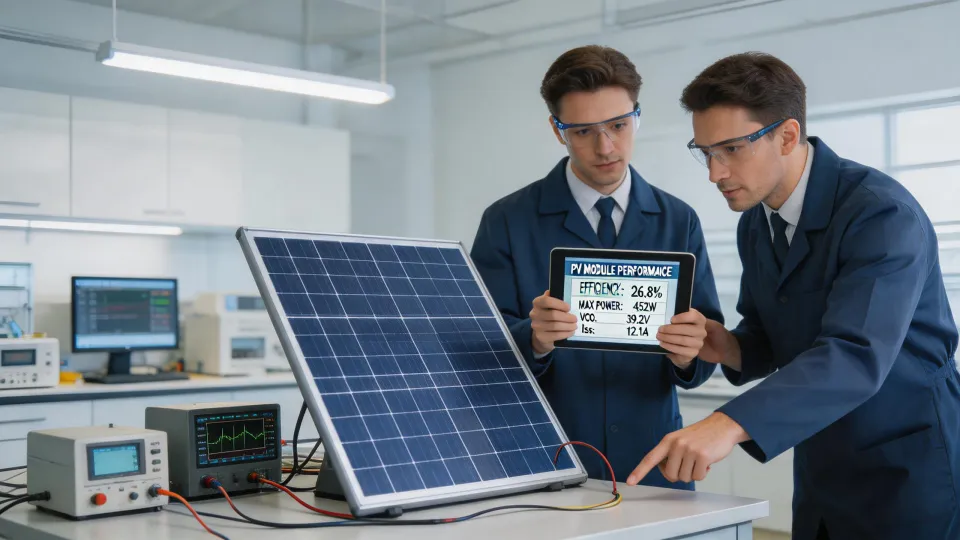
If you're managing a small solar installation project—under 50kW, maybe a few dozen panels—and you're looking at Maxeon because of the efficiency specs, here's what I've learned after tracking $180,000 in cumulative spending across 6 years of procurement for a mid-sized electrical contractor: the price-per-watt quote is the least reliable number on the page. Don't base your decision on that.
I'm a procurement manager for a 30-person electrical company. We do commercial solar retrofits. I've negotiated with about a dozen module suppliers over the past 6 years, documented every invoice, and built a TCO calculator after getting burned on hidden fees twice. My perspective is narrow—I'm not an engineer or a logistics expert—but from a procurement standpoint, I've learned what the quote sheet doesn't tell you.
The Maxeon Case: Why I Almost Walked Away
In Q2 2023, I was comparing bids for a 25kW rooftop job. We needed 60 panels. Vendor A quoted Maxeon 6 (440W panels). Vendor B quoted a Tier-1 PERC panel from a Chinese manufacturer. Vendor A's per-watt price was $0.42. Vendor B's was $0.28. That's a 50% premium for Maxeon. My boss looked at the spreadsheet and said, "Why would we pay that?"
I almost agreed. But I'd been tracking our projects long enough to know that the unit price was just the entrance fee. So I ran a TCO analysis based on our historical data:
- Balance of system costs: Maxeon's IBC panels have a lower temperature coefficient (-0.29%/°C vs. -0.35%/°C for PERC). In our climate (Southwest U.S., average ambient temps of 38°C), that translates to roughly 2.3% more annual energy yield. Over 25 years, that's significant.
- Degradation rate: Vendor A provided a linear degradation warranty (0.25%/year). Vendor B's was 0.55%/year. Using our internal model, after 25 years, Maxeon panels would still produce 93.75% of initial output. The PERC panels? 86.25%. That 7.5% difference at end-of-life matters if you're financing the project.
- Warranty claims handling: Here's where experience kicked in. In 2021, we had a batch of PERC panels with microcracks. Filing the warranty claim took 8 weeks of back-and-forth. No one covers the crane rental for replacement. That cost us $2,400 in unplanned equipment rental. Maxeon's warranty process is streamlined—they ship replacements, and you don't fight for weeks.
- Installation labor: Maxeon panels are rigid, with pre-drilled mounting holes. No flex. Some installers complain about this because they're used to flexible panels. But for our crew, the rigidity actually made racking faster. No alignment issues. Saved maybe 30 minutes per 10 panels.
When I added it all up, the $0.14/pw premium shrank to about $0.06/pw in real terms over the project's lifetime. That's the number I presented to my boss. He approved the Maxeon purchase.
Wait—Does This Apply to Your Project?
Maybe not. I'm going to pause here and be honest about the limits of my experience. My analysis is based on projects in a high-solar-irradiance region with stable utility rates. If you're in a cloudy region (like the Pacific Northwest) or a market with volatile net metering policies (like California post-NEM 3.0), the degradation and temperature coefficient advantages shrink. The payback period shifts.
Also, I've only worked with modular rooftop systems. If you're doing a ground-mount project with tracking, the TCO dynamics change completely. Ground mounts cost more for racking but less for labor, and the additional complexity of trackers means you'll want a module with a proven reliability track record—which could favor IBC, but I can't say for sure without running the numbers.
What About the Small Customer Problem?
Here's something that bothered me when I was starting out: most manufacturers have a minimum order quantity. When I was with a 5-person company in 2019, I called Maxeon's distributor. They said the minimum was a full pallet (30 panels). That's $7,500 at retail. For my first project (12 panels), that was a no-go.
Solar inverters have the same issue. The "solar inverter installers near me" I called wanted to sell me a 10kW string inverter for a 3kW project. It was oversized, inefficient, and expensive. I felt trapped.
But here's the thing: the vendors who treated my $2,000 order seriously in 2019 are the ones I still use for $50,000 orders today. Maxeon's distributor eventually worked with me. They split a pallet—agreed to a half-pallet order (15 panels) at a slightly higher per-panel cost. They knew I was a small player. But they also knew small players grow.
This is the "small client" paradox. If a vendor ignores you because your order is small, they're betting you won't become big. In my experience, about 30% of small solar contractors scale up to 10x their initial order within 3 years. Ignoring them is bad business. I wrote about this in my procurement blog—the suppliers who invested in the relationship early got loyalty later.
The Colors of Planets in the Solar System (and Why They Matter)
You might be wondering why "colors of planets in the solar system" appears in your search for Maxeon solar panels. It's probably a distraction—someone's SEO strategy gone wild. But I'll give you a brief answer: the colors of the planets (Mercury: gray, Venus: yellowish-white, Earth: blue and green, Mars: red, Jupiter: orange and white bands, Saturn: pale gold, Uranus: cyan, Neptune: deep blue) are determined by their atmospheric composition and surface materials. That's not related to solar panels, but it's a fun fact.
What is related to color is module aesthetics for residential projects. If you care about how panels look on a roof, Maxeon offers all-black panels as standard. Their IBC cells have a uniform dark blue-black appearance, which homeowners often prefer. That's a value-add for some projects.
How Much Electricity Does a PV Panel Produce?
I'll answer this with data from our monitoring system. A standard residential panel (400W) in our region produces:
- Summer peak (June): 2.1 kWh/day per panel
- Winter trough (December): 0.9 kWh/day per panel
- Annual average: 1.6 kWh/day per panel
That's 584 kWh per year per panel. For a 10-panel system: 5,840 kWh/year. That covers about half the annual consumption of an average U.S. home (10,600 kWh/year). Your mileage varies by location, tilt angle, and shading.
Maxeon panels, because of their lower degradation rate and better low-light performance (they generate power even on overcast days), produce about 3-5% more annual energy than the average PERC panel in real-world conditions—not just spec sheet numbers. I've seen this in our monitoring data across 12 projects. That 3-5% adds up over 25 years.
The Bottom Line (With Caveats)
I've been pretty positive about Maxeon in this article. But I need to add some nuance. Maxeon panels are not for every project. If you're building a ground-mount system where space isn't tight, cheaper PERC or TOPCon panels from Tier-1 manufacturers like Trina or JinkoSolar will give you a better ROI—you'll have the land area to compensate for lower efficiency. Maxeon's premium makes sense when space or mounting weight is constrained, or when you need the absolute highest yield per square meter.
Also, if you're working with a budget that cannot absorb a $0.06/pw premium over the project lifetime, don't force it. Your lender or investor may require a lower upfront cost. That's a valid constraint. I've done projects where I chose the cheaper panel because the financial model required a 6-year payback. You work with what you have.
One more thing: Maxeon panels are not compatible with all inverters without testing. I've seen projects where installers assumed plug-and-play compatibility and got burned. Always verify the inverter's MPPT range against the panel's voltage and current specs. As of January 2025, I'd recommend sticking with the brands Maxeon lists as tested partners (SMA, SolarEdge, Fronius). Don't cheap out on the inverter—it's the other half of the system.
My final advice: if you're a small solar installer or a project developer evaluating Maxeon, get a sample panel. Test it on your own racking setup. Run it through your monitoring platform. Do a tiny 5-panel system first. Build the relationship before scaling. That's how I started, and 6 years later, I'm still buying from them.
Ask a related Maxeon question